Pickleball Rules: From Serve to Kitchen
📋 LAYING THE GROUNDWORK
While pickleball has hundreds of rules, you only need a handful to get started. Knowing the basics helps beginners or anyone needing a quick refresher. Before diving into the do's and don'ts, let's start with where it all happens.
THE PICKLEBALL COURT

📋 USING THE RIGHT BALL
Pickleball can be played indoors or outdoors, and each setting uses a ball designed for its playing environment.
INDOOR BALL

Larger holes for a softer, more controlled feel.
OUTDOOR BALL

Smaller holes reduces wind effect for flight consistency.
📋 HOW SCORING WORKS
-
Calling out the Score: Each player must call out the score before serving.
-
Score Format: Each score has 3 numbers:
[Serving Team Score] - [Receiving Team Score] - [Server #1 or #2]. -
Starting Score: Player 1 opens the game by calling "0–0–2".
-
Why? The starting team gets one server turn; the opening server is designated as Server 2. It prevents the starting team from building a huge lead early on.
-
-
Standard Rotation: After the first side-out, both partners serve (Server 1, then 2).
📋 SCORING & ROTATION
-
Serving to Score: Only the serving team can earn points.
-
Switching Sides: When the serving team scores, teammates swap sides (left/right).
-
Why? To ensure the server faces a different receiver, keeping the game fair.
-
-
Serving Streaks: The same server keeps serving when the team continues scoring.
- Side-Out: When Server 2 fails to score, turn the ball over to the opponents.
📋 ENDING THE GAME
-
Target Score: Play to 11 points, win by 2 (e.g. 11-9).
-
Win-by-Two: If a team reaches 11 but only leads by 1 (e.g. 11-10), play continues.
-
Getting "Pickled": A final score of 11–0 means the losing team got "pickled!"
-
Why? It's a friendlier (and funnier) way to say you scored zero points.
-
📋 STARTING THE GAME
-
Which Side Serves First: Any fair method (like a paddle spin) picks who's first, but local courts often have a default side, like the Northwest end of the court.
-
Why? Rumor has it that's a nod to pickleball’s Pacific Northwest origins!
-
-
Which Player Serves First: It's always the player on the right side of the court.
📋 LEGAL SERVES
-
Target Area: The serve must travel into the diagonal cross-court service box. It must clear the kitchen and cannot touch the kitchen line; but touching any of the other lines is considered in bounds.
-
Foot Placement: Feet must stay behind the baseline until the ball is struck.
-
Volley Serve: The serve must be struck underhand. Paddle moving in an upward arc, making contact below the waist with the paddle head below the wrist.
-
Why? This prevents aggressive aces and keeps the ball playable.
-
-
Drop Serve: Release the ball by gravity from any height and hit it off the bounce.
-
Net Serve: A ball clipping the net and landing in bounds is live.
📋 RECEIVING THE SERVE
-
Receiver Position: Anywhere diagonal from the server, on or off court.
-
First Contact: Only the designated receiver may return the serve.
-
Partner's Position: Anywhere on or off court, though typically at the Kitchen line.
-
The 2-Bounce Rule: The receiver must let the serve bounce. Then, the serving team must also let the return bounce.
-
Why? It prevents immediate net smashes, allowing time to establish the rally.
-
📋 THE KITCHEN
-
The No-Volley Zone: Volleying inside the Kitchen or touching its line is a fault.
-
Why? It prevents players from camping at the net to smash every shot.
-
-
The Safe Entry: You may step into the kitchen if the ball has already bounced.
-
Watch the Momentum: Stepping into the Kitchen from a volley is a fault.
📋 LINE CALLS
-
On Serve:
-
IN: In the diagonal service box, touching the baseline, sideline, or centerline.
-
OUT: In the Kitchen, or touching the Kitchen line.
-
-
Regular Play
-
IN: In the diagonal service box, touching the baseline, sideline, or centerline.
-
OUT: In the Kitchen, or touching the Kitchen line.
-
📋 DISPUTES
-
Line Call Authority: Each team calls the lines on their side of the net, and their call is final. Spectators may offer an opinion, but they have no call authority.
-
When Unsure: Default is IN if your team missed the bounce or partners disagree.
-
Kitchen Faults: Opponents can call Kitchen step-ins; if disagree, simply replay.
-
Two-Bounce Fault: You self-call if you didn't let it bounce; if an opponent points it out and you disagree, your call stands.
-
Agree to Disagree: Official rules allow a replay if no one saw the bounce.
Pickleball is fast to pick up, and the core rules matter for players of all levels:
-
Newbies: Learning the basics prevents early confusion and gets you in the game.
-
Rising players: Mastering standard rules accelerates your progress.
-
Seasoned players: Knowing rule nuances unlocks tactical edges and confidence.
(For tournament standards or full technical details, please refer to the official USA Pickleball Rulebook.)

▶️ A SAMPLE PLAY
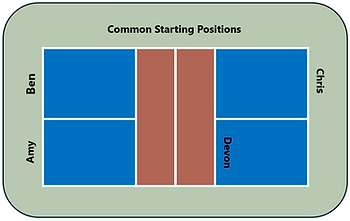
To see pickleball rules apply in real time, let's follow two short rallies and the score progression: 0-0-2 ➜ 1-0-2 ➜ 0-1-1 ➜ 1-1-1 ➜ 1-1-2
-
Team 1: Amy & Ben
-
Team 2: Chris & Devon
▶️ FIRST POINT
-
The Opening Serve: Amy on the right side serves first. She calls out "0–0–2" (act as Server 2 for the starting team) and hits an underhand serve cross-court to Chris.
-
The First Bounce: Seeing the serve touch the sideline (outer lines are in!), Chris lets it bounce before hitting a return deep into Team 1's court.
-
The Second Bounce: Amy lets the return bounce before hitting it back to Team 2—completing the Two-Bounce Rule.
-
Kitchen Fault: Devon from Team 2 steps into the Kitchen to hit Amy’s shot out of the air, committing an illegal volley!
-
Team 1 Scores: Point to Team 1! Amy swaps sides with Ben.
▶️ SECOND POINT
-
Serve Fault: Amy now serves from the left, calls out "1-0-2" and serves to Devon. The ball lands in Team 2's Kitchen—Fault!
-
Side-Out: Amy's fault ends Team 1's turn immediately. The ball goes to Team 2.
-
Team 2 Scores: As Server 1 on the right, Chris calls out "0-1-1" and drop serves to Ben. After a good rally, Team 2 ties at "1-1-1". Chris and Devon swap sides.
-
Serve Fault: Chris serves from the left side to Amy. The ball touches Team 1's Kitchen line—Fault!
-
Second Server: Since Team 2 gets two full server turns, Devon on the right steps up as Server 2 calling out "1-1-2" and serves to Ben. Devon will keep serving until Team 2 commits another fault, which will trigger a Side-Out back to Team 1!
📋 THAT'S A RULE?
The standard rules keep the peace, but the funny ones unleash the chaos!
-
Nasty Nelson: If a serve hits the receiver or their partner before it bounces, it’s a fault on the receiving team, giving the serving team the point.
-
Yep: A serve hitting a receiving player costs the point. Go figure.
-
-
Partner Problem: If a ball already in play hits you or your partner before it bounces, your team loses the rally.
-
Yep: For once, blaming your partner for losing a point is justified as it's backed by the official rulebook—for getting in the way or failing to dodge.
-
-
Erne: A player can legally volley from outside the court, alongside the kitchen, as long as their feet aren’t touching the kitchen or its line when the ball is struck.
-
Yep: It looks like leaving the court, but it’s actually a perfectly legal shortcut around the kitchen.
-
-
Around The Post (ATP): A player can return the ball around the outside of the net post instead of over the net, as long as it lands in the opponent’s court.
-
Yep: Apparently, the net is optional.
-